South Korea
Winter in SokchoSouth Korea appears in the novel as both an inhabited country and a landscape shaped by division. Around Sokcho, winter beaches, harbour works, checkpoints, and a border museum place everyday encounters within reach of the unresolved conflict with North Korea; the frontier is at once a tourist destination and a continuing pressure on local life.
Coastal Setting and Regional Landscape
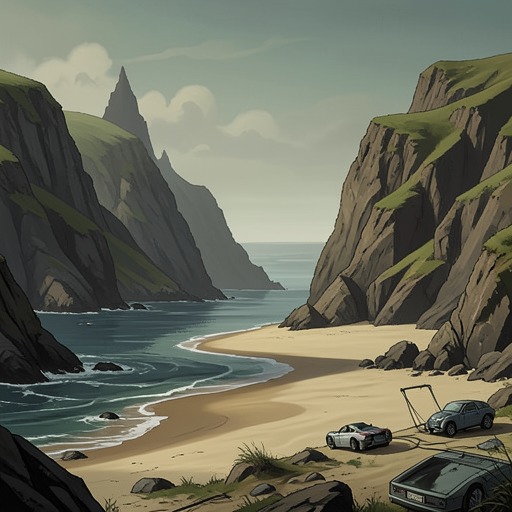
The narrator loves the coastline near Sokcho, even though electrified barbed wire runs along the shore and the border with North Korea lies barely sixty kilometres away. The juxtaposition makes the national landscape difficult to separate from its military boundary: the beach is beautiful, but visibly scarred by the measures that divide the peninsula.
Further inland, the road through Gangwon Province passes skeletal village remains, discarded cardboard and plastic, and blue metal sheets. The narrator describes the province as having been left to decay since the Korean War. These details give the border journey a wider setting of postwar neglect rather than isolating it as a single military attraction.
The Frontier as a Managed Space
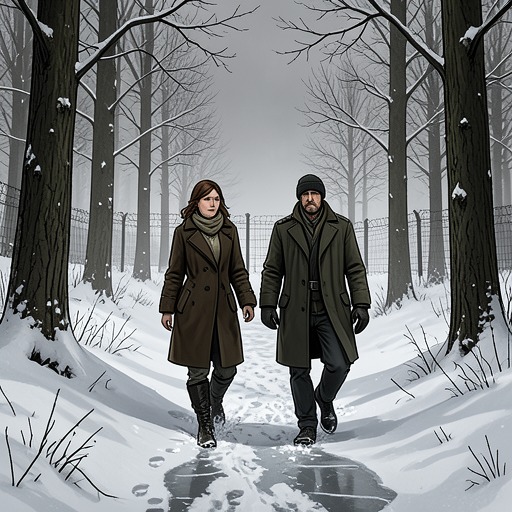
At the checkpoint, a young soldier requires the narrator and her companion to complete forms. A loudspeaker repeatedly lists restrictions: no photography or filming, no leaving the marked path, and no loud voices or laughter. After the forms are returned, a fence opens onto no man's land. An armed convoy initially escorts the visitors, then turns away, leaving them to continue alone along a road between snow-filled ditches.
The observation point presents the frontier as something to be seen under controlled conditions. Visitors climb to binoculars and can look toward North Korea for five hundred won, but the cold makes their eyelids stick to the metal frames. The view offers little beyond ocean, mountains, and fog. The apparatus promises access to the other side while the weather and the border's restrictions frustrate that promise.
War, Museum, and Public Memory
At the museum, an entrance booth charges five thousand won for two people. Inside, the narrator translates a display explaining that the conflict began in 1950, with North Korea supported by the Soviet Union and China and South Korea by the United States and the United Nations. The display identifies the Korean Armistice Agreement, signed on 27 July 1953, and describes the frontier along the 38th parallel as the world's most heavily militarized border, set within a no-man's-land four kilometres wide and 238 kilometres long. It gives a death toll of two to four million, civilian and military, and notes that no peace treaty was ever signed.
The museum's historical account is accompanied by objects that make division tangible in a different register: schoolchildren's shoes from the North and blue-packaged Choco Pies. The narrator wonders whether the cakes are real or specially made for display. Her attention to this small uncertainty contrasts with the museum's monumental figures, showing how the border is encountered not only through military history but through the everyday goods and ordinary lives it separates.
Tourism and the Lived Meaning of Division
The observation point and museum turn the frontier into a destination for visitors; the narrator remarks that tourists are the only people who come there. Yet the trip does not make the border merely historical or scenic. A woman in a pink jacket stands beside the road, watches the car pass, and later approaches the narrator at the tteok stall, touching her cheek. The encounter interrupts the ordered itinerary and brings an individual presence into a landscape otherwise organized around signs, routes, and viewing facilities.
The narrator explains that South Korea's beaches are still waiting for the end of a war that many people have stopped believing is real. Hotels and neon signs, she says, coexist with a sense of living in limbo, as though the apparent normality could give way at any moment. She recalls that the previous summer a tourist from Seoul was shot by a North Korean soldier while swimming in the sea, unaware that she had crossed the border. The incident makes the division immediate and bodily: even a beach can become a dangerous boundary without a swimmer recognizing it.